
565,253 dictated words, one dented forehead, and a hypothesis about the quiet interface revolution hiding beneath the AI headlines
Part one of a three-part Deep Thoughts and What Not’s series about what happens when our computers become better at capturing how we think.
Some days, I leave my office with a dent in my forehead.
It comes from leaning against the shock mount attached to my Yeti microphone while I talk. Not for a few minutes. Sometimes for hours.
This is further evidence that I would be intolerable in an open office.
Imagine sitting three desks away while I narrate a software test, develop a training scenario, rewrite an email, argue with an AI, and discover four unrelated business ideas before lunch.
Fortunately, I work remotely.
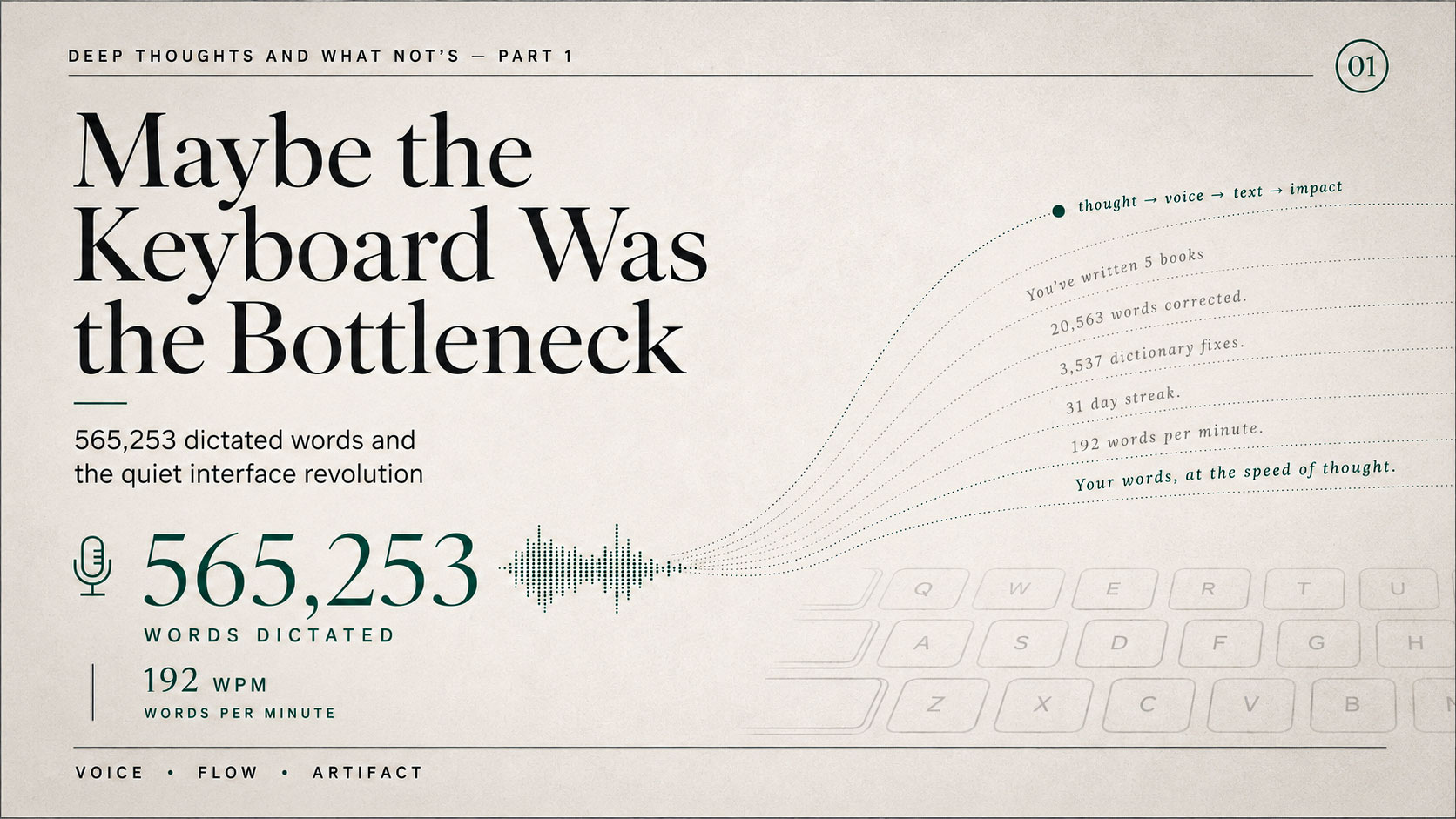
Unfortunately for my forehead, I recently learned that I have dictated 565,253 words using Wispr Flow.
The app describes that as five complete books.
I did not set out to dictate five books. I was trying to make things: applications, reports, newsletters, learning experiences, client communications, prototypes, scripts, research, software tests, and all the strange connective tissue that eventually turns an incomplete thought into something useful.
My dashboard also says I have a 31-day streak.
That is technically true, but slightly misleading. Thirty-one days is simply how long it has been since I last took a day off. There were probably another 20 or 30 days before that, followed by another stretch before that.
The only time I am consistently not using Wispr Flow is when my wife and I are sleeping in our rooftop tent somewhere in the mountains.
Apparently, trees remain one of the few places where I stop prompting.
Does my brain actually move faster?
People who know me have told me for years that my brain moves unusually fast.
That sounds flattering, but it is not especially scientific. There is no dashboard in my skull reporting that Cameron’s Brain is operating in the top 0.1 percent, although Wispr does make that claim about my speaking speed.
What I can say with more confidence is that typing has never kept up with the way I naturally develop ideas.
I type badly.
I make spelling mistakes. I change direction halfway through sentences. I stop to repair grammar that did not need to be repaired yet. I delete the same word five times while the larger thought quietly climbs out a window.
Wispr reports that I dictate at approximately 192 words per minute.
A large study based on 136 million keystrokes from 168,000 volunteers found that the average participant typed about 52 words per minute. Professionally trained typists commonly reached somewhere between 60 and 90. (cam.ac.uk)
At those rates, my 565,253 dictated words represent approximately:
- 49 hours of active dictation
- 181 hours of average-speed typing
- A theoretical difference of roughly 132 input hours
- More than 16 eight-hour workdays
That comparison is imperfect.
Typing tests usually measure the transcription of prepared text. They do not fully capture what happens when someone is inventing, planning, editing, correcting, reconsidering, and trying to remember why the document exists in the first place.
Wispr’s measurement is not necessarily identical to the methods used in academic typing studies either.
Still, the difference is not hiding behind a decimal point.
In a Stanford-led experiment comparing speech recognition with smartphone typing, English speech input reached 153 words per minute compared with 52 for typing, making speech approximately 2.9 times faster under controlled conditions. Speech also produced fewer corrected errors during entry, although slightly more uncorrected errors remained in the final text. (arxiv.org)
My recorded ratio is closer to 3.7 times.
The useful conclusion is not that I am some uniquely accelerated human specimen.
The more interesting hypothesis is this:
Perhaps my thinking was not the bottleneck. Perhaps the interface was.
Dictation used to create a second job
Speech-to-text is not new.
For years, we were promised that dictation would free us from the keyboard. In practice, it often replaced slow typing with fast cleanup.
You had to speak with the precision of an air-traffic controller:
New paragraph. Open quotation mark. Delete previous word. No, previous word. Previous previous word.
The software would misunderstand a name, substitute an unrelated word, miss the punctuation, and leave behind a document that looked as though it had been translated through three languages and a malfunctioning fax machine.
Yes, you could produce more words.
You could also produce a much larger archaeological site to excavate later.
Sometimes it was easier to keep typing, delete the same word five times, and negotiate directly with the little red squiggly line.
The important change is not merely that transcription has become more accurate.
It is that AI can now make sense of language that is not yet clean.
I do not need to dictate a perfectly constructed document. I need to provide enough signal for the system to understand:
- what I am trying to accomplish,
- what context matters,
- what I noticed,
- what I dislike,
- what I want to change,
- and what the thing might become.
The breakthrough is not simply speech-to-text.
It is intent-to-artifact.
My grandfather already had this interface
My grandfather’s generation understood part of this workflow.
Back when the two-martini lunch was not a television joke but a calendar event, executives did not necessarily sit down and type their own correspondence.
They dictated letters.
They might walk around the office, speak in half-formed paragraphs, revise a sentence aloud, and hand the verbal fog to a secretary, receptionist, or office assistant who understood shorthand, typing, grammar, tone, and probably the exact moment to pretend they had not heard something.
The executive supplied the intent.
Another person absorbed the friction.
It was an excellent system, provided you were the executive.
The rest of us eventually became our own thinkers, typists, editors, proofreaders, formatters, filing clerks, and occasional IT departments. Every idea had to squeeze through the same narrow keyboard before it could become useful.
AI has quietly returned part of the old executive dictation model.
We just lost the corner office, stenography pad, payroll, and medically questionable lunch.
I can sit at my desk and speak as quickly and imperfectly as I think. A computer captures the language, repairs parts of it, identifies patterns, organizes the material, and helps turn it into something another person can use.
I have apparently recreated the 1960s executive suite, except the secretary is artificial, the bar cart is missing, and I am both the boss and the person most likely to be asked to keep it down.
The website review that stopped being a project
Recently, an old friend asked me to look at his website and tell him what I thought.
That sounds like a small favor.
Historically, it could have become a fairly large task.
I would have needed to browse the site, remember what I noticed, take notes, revisit certain pages, organize the observations, soften anything that sounded too abrupt, and write a response that justified the time he had taken to ask me.
Instead, I turned on Granola and explained what I was doing:
I am transcribing this as a UAT session. I am going to narrate what I notice as I move through the website.
Then I used the site.
I went through it once, then again, and then again. I talked about the visual hierarchy, credibility, wording, navigation, places where the experience felt strong, and places where it became less clear.
I did not stop to make every sentence elegant.
I did not switch between browsing and note-taking.
I did not attempt to reconstruct my first impression after the first impression had already disappeared.
When I stopped, Granola took a few minutes to turn the session into usable notes.
Something that could have consumed a large piece of the afternoon became an easy favor.
More importantly, the feedback remained honest.
It had not been slowly converted into polished corporate oatmeal by the effort of rebuilding it later. It captured what I actually experienced while using the site: where I hesitated, what caught my attention, what felt credible, and where the story weakened.
The thinking became the documentation.
AI gives us more reps
The most underappreciated advantage of AI may not be that it makes one attempt faster.
It is that it gives us many more attempts.
When I am building an application, report, learning experience, or AI-powered tool, I may conduct ten or twelve narrated UAT sessions.
I open the latest version.
I explain what I am seeing, what works, what feels awkward, what is missing, what broke, and what I expected to happen instead.
That narration becomes a transcript.
The transcript goes back into AI.
AI helps interpret it, organize the issues, make revisions, and produce another version.
Then I do it again.
Build. Narrate. Interpret. Revise. Test again.
Traditional productivity math asks how much faster AI allows us to complete one deliverable.
That misses the richer advantage.
The better measure may be iteration density: how many meaningful cycles can I complete while the problem is still fully loaded in my head?
Previously, every revision cycle carried administrative drag.
I had to take notes, clean the notes, organize the notes, explain the notes, and then make the changes.
That friction encouraged compromise.
I might review something once, fix the obvious problems, and decide it was probably good enough.
Not because I lacked judgment.
Because repeatedly applying that judgment was expensive.
AI changes the economics of revision. When each cycle becomes cheaper, I can take more swings before leaving the batting cage.
The work improves not because AI produces perfection, but because I can keep testing and correcting while I still remember what perfection was supposed to look like.
Creative context has a half-life
There is real value in sleeping on an idea.
Distance can reveal weak logic. A fresh morning can expose the paragraph that only seemed brilliant because it was written at 1:14 a.m.
But stopping also has a cost.
When I return to a project, I have to reload it:
What was I trying to accomplish?
Why did I make this choice?
Which version was current?
What was bothering me?
What did I plan to do next?
Why did this feel exciting yesterday?
Some of that context returns. Some does not.
That is why I often work in sprints. When I enter a flow state, I may stay with something for many hours. Occasionally, that means going for 15 hours until the idea reaches what I think of as a stable state.
Stable does not mean finished.
It means the important thing now exists outside my head. The structure is visible. The logic has been captured. The fragile energy that made it interesting has been converted into something sturdy enough to survive my absence.
Research into writing offers a plausible explanation for why mechanical friction matters. Planning ideas and generating sentences both place demands on working memory. (jowr.org)
Research into interruptions also describes a “resumption lag,” the period required to recover and resume a primary task after attention has been diverted. Reconstructing the original task context can itself require cognitive work. (pmc.ncbi.nlm.nih.gov)
That does not prove that correcting one typo destroyed my creativity.
It supports a more modest claim:
Every unnecessary interruption competes with the thought I am trying to keep alive.
Voice does not eliminate cognitive load.
It allows me to spend more of it on the idea.
Voice preserves momentum. AI preserves meaning.
My old typing process forced creation and correction to happen almost simultaneously.
I would generate a sentence, notice its grammar, repair it, reconsider the wording, question the point, and lose the larger trail I had been following.
Voice and AI allow me to separate more of that work.
Voice becomes the generator.
I can wander, connect ideas, follow strange branches, repeat myself, reverse course, and continue speaking until the shape begins to emerge.
AI becomes part of the evaluator.
It can organize, compare, question, research, restructure, and help determine which parts deserve to remain.
Typing often encouraged me to polish the sentence while the idea was still trying to be born.
Dictation lets me mine the ore before deciding which pieces should become jewelry.
Or gravel.
There is always gravel.
The picks and axes of AI
Much of the AI conversation is aimed at the spectacular.
We talk about agents replacing departments, synthetic video, autonomous software, robots, and models that apparently become smarter every Tuesday.
Those developments matter.
But some of the largest practical gains may come from much smaller changes in the normal day:
- not losing an idea while correcting a word,
- not cleaning a transcript before it becomes useful,
- not taking separate notes while testing something,
- not rebuilding context every time a project resumes,
- not translating natural intent into rigid software commands,
- not needing a polished prompt before beginning.
These are the picks and axes of the AI era.
They are not as exciting in a keynote.
They are more useful on a Wednesday.
My Wispr dashboard reports 24,100 fixes across those 565,253 words. It also shows 10,514 AI prompts across 41 desktop applications.
Those numbers reveal something larger than a speech habit.
They describe a production system.
More thoughts get captured.
The captured thoughts can be curated.
The curated material can become applications, training, research, newsletters, tests, decisions, and feedback.
Then the response creates another round of thought.
Capture → Curate → Share → Respond → Improve
Once that loop becomes fast enough, it stops feeling like a collection of administrative tasks.
It becomes one continuous act of making.
The accelerator still needs brakes
There is a red-team version of this story.
Flow feels productive, but sustained momentum can conceal declining judgment, repetition, physical fatigue, and the fact that I have apparently been pressing my forehead into a piece of podcast equipment for half a day.
The same system that removes my natural stopping points may require me to create artificial ones.
Going from zero to a stable state in one sprint can preserve the original energy of an idea.
It can also turn the operator into a highly productive Victorian ghost.
More output is not automatically better output.
More iterations do not help if fatigue makes each one less perceptive.
The future workflow needs both:
- a larger creative accelerator,
- and a better braking system.
My hypothesis is not that everyone should speak continuously until they collapse near a microphone.
It is that we should pay closer attention to the interfaces that either preserve or fracture the way we think best.
Maybe the interface is the story
I have used trackballs, touchscreens, styluses, strange mice, split keyboards, virtual-reality headsets, and enough productivity software to qualify as a small institutional buyer.
None has changed the way I interact with a computer as much as being able to narrate what I am thinking and have the system understand what I mean.
Most computer interfaces required humans to adapt themselves to the machine.
We learned commands.
We selected the correct menu.
We completed the approved field.
We compressed complicated intentions into whatever structure the software could accept.
AI begins to reverse that relationship.
The computer increasingly adapts to us.
It can tolerate abandoned sentences, missing punctuation, repetition, corrections, nonlinear thought, and the verbal debris surrounding a worthwhile idea.
The only interface I can imagine surpassing this is some Neuralink-like system that removes speech from the chain entirely.
No keyboard.
No microphone.
No sentence required.
The thought travels directly into the machine.
That sounds wonderfully efficient.
It also sounds like a spectacular way to discover how many of my thoughts should never escape quality control.
Until then, voice may be close enough.
I can think aloud. The software can tolerate the wreckage. AI can locate the idea inside it. And before the original spark disappears, I can turn it into something stable enough to survive the night.
Maybe that is the overlooked AI revolution.
Not that the machine can think for us.
That, for the first time, it can keep up while some of us think out loud.
Next in the series
This article begins with one person, one microphone, and a computer capable of turning narration into useful material.
The next article moves from I to we.
What changes when Zoom, Teams, Google Meet, Granola, and similar tools capture not only a meeting’s decisions, but the differing perspectives, disagreement, context, and reasoning that produced them?
Perhaps the conversation was not merely something that happened before the work.
Perhaps the conversation was the work.
Leave a Reply