Podcast: Deep Thoughts and Whatnots

  • WHEN THE COMPUTER LEARNS TO WAIT

    Deep Thoughts and Whatnots
    Deep Thoughts and Whatnots
    WHEN THE COMPUTER LEARNS TO WAIT
    Loading
    /

    We taught machines to speak. The larger breakthrough may be teaching them when not to.

    Part three of a Deep Thoughts and What Not’s series about how AI is changing the way we capture, curate, and share human thought.

    In the first article in this series, I explored what happened when I stopped forcing every idea through a keyboard.

    After dictating 565,253 words, I began to wonder whether typing had been more than a minor inconvenience.

    Perhaps my thinking was not the bottleneck. Perhaps the interface was.

    Voice allowed me to capture ideas at something closer to the speed they arrived. AI could make sense of the wrong words, abandoned sentences, corrections, and verbal detours surrounding the actual idea.

    One voice could become an artifact.

    In the second article, the idea expanded from I to we.

    When we capture a meeting, we preserve more than the tidy notes produced afterward. We preserve the conversational trail: the disagreement, expertise, false starts, context, and unexpected comments that explain how a group reached a decision.

    Many voices could become a corpus.

    Now we have arrived at the third shift.

    The machine is no longer waiting at the end of the process to clean up what we said.

    It is entering the conversation itself.

    Not merely as a voice attached to a search box.

    Not as a chatbot waiting for us to complete a perfectly shaped question.

    As something closer to a live thinking partner that can listen while the thought is still becoming a thought.

    And, perhaps most importantly, it is learning to wait.

    The problem with talking to a computer

    Voice assistants have always carried a peculiar social pressure.

    You begin speaking.

    You pause for half a second because the next sentence has not fully arrived.

    The machine decides you have completed your remarks and launches into an answer to a question you had not finished asking.

    You interrupt it.

    It interrupts your interruption.

    You apologize to your phone.

    The phone does not acknowledge the apology because it is still explaining the wrong thing.

    Talking to a computer was supposed to feel natural, but it often required a strange kind of artificial fluency. You had to speak in complete blocks, avoid meaningful pauses, and signal clearly when your turn had ended.

    Real conversation does not work that way.

    Human beings hesitate.

    We restart sentences.

    We use silence to search for language.

    We make a point, realize it is wrong while making it, and reverse course before arriving at the period.

    We say, “Hold on, I’m still thinking.”

    We make noises that are not technically words but somehow communicate that the other person should continue.

    A good listener understands that a pause is not always an invitation to seize the floor.

    Computers have historically been terrible at that distinction.

    The machine can finally share the floor

    OpenAI has introduced GPT-Live, a new voice system now powering its latest ChatGPT Voice experience.

    The technical phrase behind it is full duplex. In practical terms, that means the model can continuously listen while generating a response instead of treating the conversation as a rigid exchange of separate turns.

    It can make repeated decisions about whether to speak, continue listening, pause, interrupt, or use a tool. When a request requires deeper reasoning or research, the live model can delegate that work to another model while maintaining the conversation.

    That may sound like an incremental improvement.

    It is not.

    Awkward turn-taking was one of the remaining barriers between using AI as a tool and using AI as a place to think.

    A text box waits indefinitely, which is useful.

    A human conversation responds fluidly, which is also useful.

    Earlier voice systems sometimes inherited the weaknesses of both. They created the time pressure of a live conversation without possessing the social awareness required to manage one gracefully.

    They could speak.

    They had not yet learned how to share the floor.

    GPT-Live is designed to follow pauses, interruptions, and changes in pace, deciding in the moment whether to respond or keep listening. OpenAI says the new system performed better than its previous voice experience in evaluations involving turn-taking, interruptions, conversational flow, and perceived naturalness.

    The product will still make mistakes. A dog barking, a bad connection, or my tendency to begin a sentence in one county and finish it in another can still confuse the machinery.

    But the direction is important.

    The computer is becoming less dependent on a clean stopping point.

    That changes what we can do before the stopping point arrives.

    A conversation without quite as much pressure

    There is an odd advantage to thinking aloud with AI.

    It can feel conversational without placing the same burden on you that comes with occupying another person’s time.

    You can take ten minutes to locate a point that eventually requires one sentence.

    You can try three versions of the same explanation.

    You can begin with confidence, discover halfway through that your premise is wrong, and walk the entire thing backward.

    You can repeat yourself.

    You can ramble.

    You can ask the AI not to answer yet.

    You can use the conversation to discover what you are trying to say.

    That would be a lot to ask from a coworker at 4:45 on a Friday.

    A good human collaborator may be patient, but they still have a calendar, an inbox, a family, and a visible expression when you begin explaining the same idea for the fourth time.

    AI does not eliminate the value of human conversation.

    It creates a different kind of conversational space.

    Personal without requiring another person. Conversational without quite as much social pressure. Captured without requiring a separate documentation step.

    That combination matters because I no longer have to arrive with the thought fully organized before I begin exploring it.

    The conversation can become the organizing process.

    People have always used conversation this way.

    We call a friend.

    We pace around an office.

    We explain a problem to someone who may not understand the technical details but knows how to ask the question that reveals we do not understand them either.

    Software developers have long practiced “rubber duck debugging.” Explaining code line by line to an inanimate rubber duck can expose errors because the act of explanation forces hidden logic into the open.

    AI gives the duck an advanced degree, access to current research, and an almost supernatural enthusiasm for numbered lists.

    It can listen to the explanation and then identify a contradiction, question an assumption, find relevant evidence, compare alternatives, or turn the emerging idea into a plan.

    The duck can now help build the software.

    The conversation becomes the workspace

    We have spent several years teaching people how to prompt AI.

    Give it a role.

    State the goal.

    Provide context.

    Define the format.

    Include examples.

    Specify the constraints.

    These remain useful habits. Clear thinking usually produces clearer instructions.

    But a fluid conversation changes how much preparation has to happen before the interaction begins.

    I do not always need one polished prompt.

    I can begin with:

    I have the beginning of an idea, but I do not know what it is yet.

    Then I can explain.

    The AI can ask what I mean.

    I can correct its interpretation.

    It can offer a structure.

    I can reject the structure.

    It can find evidence.

    The evidence may change the premise.

    The context accumulates conversationally.

    Instead of compressing my entire intention into one expertly engineered instruction, I can reveal it over time.

    That is often closer to how genuinely complicated problems are solved.

    We do not always know enough at the beginning to ask the correct question.

    Sometimes the question is the first thing the conversation needs to produce.

    This transforms the chat from a sequence of requests into something closer to a workspace.

    Inside one exchange, I can explore an idea, add text or an image, look for current information, question the answer, return to an earlier point, and begin creating the artifact that emerges.

    ChatGPT Live can currently work with text and images in the same conversation and can use capabilities such as web search and memory where available. At launch, however, it does not support everything across every plan or product. Connected apps, custom GPTs, video, screen sharing, and some workspace environments have limitations or may require an older voice mode.

    The transcript is also not a courtroom record. OpenAI notes that the transcript added to the chat may differ from what was actually said, particularly when people speak over one another, background noise is present, or the conversation moves quickly.

    That matters.

    The transcript is useful material, not infallible evidence.

    We should not confuse the direction of the interface with the maturity of the current release.

    This is still early.

    But we are clearly moving from issuing commands to computers toward developing ideas with them through continuous conversation.

    Personal, conversational, and captured

    Three qualities are beginning to converge.

    It is personal

    The system can draw on the current conversation and, where enabled, information it remembers from earlier interactions.

    It can understand which projects I am working on, which terminology I use, which explanations I have already rejected, and which ideas keep resurfacing.

    It is conversational

    I do not have to structure every interaction as a finished question followed by a finished answer.

    The thought can unfold through corrections, pauses, questions, interruptions, and changes in direction.

    It is captured

    Afterward, there is still material.

    The exchange remains in the chat history. I can revisit it, summarize it, reorganize it, quote it, or use it as the beginning of something else.

    That final quality connects the entire series.

    The value is not limited to what the AI says back.

    The conversation itself becomes an artifact.

    It contains:

    • the questions I asked,
    • the assumptions I began with,
    • the alternatives we explored,
    • the evidence that changed the direction,
    • the language I naturally used,
    • the ideas I rejected,
    • and the path I followed before arriving somewhere useful.

    That is an enormous pile of unstructured words.

    Which sounds terrible until you remember that modern AI is unusually good at finding relationships inside enormous piles of unstructured words.

    Every narrated test, meeting transcript, voice conversation, newsletter draft, project note, and AI exchange can become another piece of a personal intellectual archive.

    Most of us are not organizing the material that way yet.

    We are scattering it across chat histories, drives, meeting platforms, inboxes, and tools with charming names that will eventually be acquired or quietly vanish.

    But the material exists.

    A traditional archive preserves the outputs:

    The report.

    The article.

    The presentation.

    The finished design.

    A conversational archive can preserve more of the process that produced them.

    Not only what I concluded, but how I reached the conclusion.

    Not only the successful idea, but the five wrong turns that taught me what the successful idea needed to become.

    From personal archive to intellectual inheritance

    I sometimes describe this as building a personal LLM.

    That is understandable shorthand, but it is not technically precise.

    Most people will not train a complete language model from scratch on everything they have ever said.

    A more likely system will connect a capable general model to a private personal corpus:

    Conversations.

    Writing.

    Voice notes.

    Photographs.

    Project histories.

    Recorded decisions.

    Preferences.

    Explanations.

    The model supplies broad language and reasoning abilities.

    The archive supplies personal context.

    To the person using it, that distinction may eventually feel academic.

    They will say:

    Ask Cam’s AI.

    They will not say:

    Query the frontier foundation model using retrieval across Cam’s carefully permissioned personal corpus.

    Although the second version would look excellent on a family reunion T-shirt.

    This is where the rabbit hole becomes stranger.

    Today, we understand people from the past through whatever happened to survive.

    Letters.

    Journals.

    Photographs.

    Recorded interviews.

    Business documents.

    Stories passed through relatives who remembered the important parts, forgot the inconvenient parts, and improved the ending.

    Most ordinary human reasoning disappeared.

    The question someone considered but never wrote down vanished.

    The idea they explored and rejected left no trace.

    The explanation they gave during a meeting evaporated when everyone left the room.

    Our descendants may inherit something very different.

    They may inherit years of conversations, meeting transcripts, AI exchanges, voice notes, articles, project histories, and explanations of why we made particular choices.

    A great-grandchild may eventually say:

    “We should look at Great-Grandfather’s LLM and see what he was thinking back then.”

    Technically, the child may be asking a future model to interpret the personal corpus left behind by the great-grandfather.

    The child will not care.

    To them, the interface may feel less like opening a box of old documents and more like entering a place where questions can be asked.

    Researchers have already begun examining this possibility through concepts such as “generative ghosts” and AI afterlives, meaning interactive systems built from a deceased person’s digital traces. The research identifies possible uses in remembrance and legacy, alongside substantial concerns involving privacy, identity, consent, representation, and emotional harm.

    The possibility is moving out of pure science fiction.

    The wisdom of doing it remains a much harder question.

    Great-Grandfather’s LLM needs footnotes

    A future AI built from my words would not be me.

    This distinction must remain bright enough to see from space.

    It would not possess my consciousness, my private experience, or my actual memories.

    It would be a system generating answers from the evidence I left behind.

    Potentially useful evidence.

    Potentially intimate evidence.

    Still evidence.

    A model could capture recurring language while missing the expression on my face when I said it.

    It could mistake brainstorming for belief.

    It could merge opinions held twenty years apart.

    It could give far too much importance to a bad afternoon simply because I happened to speak more that day.

    It could reproduce an old position after I had quietly changed my mind.

    It could generate a plausible answer to a question I never addressed.

    The responsible version of this future cannot be a chatbot that confidently improvises what a dead person “would have said.”

    It needs footnotes.

    Dates.

    Sources.

    Context.

    Confidence levels.

    A visible distinction between something the person said repeatedly, something they wrote once, something they explored as a possibility, something they rejected, something inferred by AI, and something the system simply does not know.

    It should be able to say:

    He discussed this subject seven times between 2026 and 2031. His view appears to have changed after this project. Here are the original conversations.

    That is different from:

    Great-Grandfather believes you should buy cryptocurrency.

    Especially if Great-Grandfather mentioned Bitcoin once, sarcastically, while trying to fix a lawn mower.

    The archive should help people encounter the record.

    It should not impersonate certainty.

    Researchers studying these digital legacies have emphasized similar concerns, including identity consistency, intrusiveness, control, privacy, and the wishes of the person being represented.

    Who owns the archive?

    Who can question it?

    Can the person delete parts of it while alive?

    Can they restrict certain subjects?

    Can family members alter it?

    Can an employer claim the conversations created at work?

    Can the system speak in the person’s voice, or should it be limited to retrieving and explaining source material?

    Those are not minor ethical details to address after the demo.

    They determine whether the product is a thoughtful archive or a very convincing séance run by a cloud provider.

    A thinking partner is not a replacement person

    The risks are not all waiting in the distant future.

    A conversational AI can help develop an idea without guaranteeing that the idea deserves development.

    It can ask useful questions.

    It can also follow a faulty assumption too obediently.

    It can challenge me.

    It can also provide an elegant explanation for something that began with a false premise.

    A warm voice, quick response, and natural rhythm may make the answer feel more trustworthy than it is.

    The sensation of being understood is not evidence that the system is correct.

    In one controlled study involving simulated witness interviews, participants questioned by a generative chatbot developed substantially more false memories than those in the control condition. The researchers were studying a deliberately suggestive and sensitive scenario, not everyday brainstorming, so the result should not be stretched beyond its setting. But it demonstrates that conversational systems can influence what people remember and how confident they feel about it.

    A thinking partner changes the thinking.

    Human or artificial.

    That influence deserves inspection.

    The absence of human pressure is part of the appeal. It is also part of the limitation.

    An AI will listen late at night.

    It will respond immediately.

    It will not become bored.

    It may appear endlessly patient, attentive, and interested.

    That makes it useful for rehearsal, reflection, research, and creative exploration.

    It may also tempt us to substitute a frictionless synthetic conversation for the harder reciprocal relationships that keep human beings connected to one another.

    A real collaborator has their own knowledge, needs, incentives, history, and right to disagree.

    They may misunderstand me in a way that reveals my explanation is incomplete.

    They may refuse the premise.

    They may say:

    You have explained this four times, and I still do not think it makes sense.

    That friction can be valuable.

    The most useful role for conversational AI may sit somewhere between a tool, a rehearsal space, and a collaborator.

    I can use it to externalize an unformed idea, locate the missing question, test the logic, find contrary evidence, organize the material, and create the first artifact.

    Then I can take that better-developed thinking to another person.

    The machine can help prepare the thought.

    People still help determine whether the thought matters.

    The conversation becomes the production loop

    Across these three articles, the same pattern has kept reappearing:

    Capture → Curate → Share

    The first article focused on individual capture.

    Voice let me externalize ideas without repeatedly stopping to type, correct, and reload the thought.

    The second focused on collective capture.

    Meeting transcripts preserved the reasoning and knowledge that traditional notes compressed or discarded.

    This third article brings capture and curation into the conversation itself.

    I state the idea.

    The AI asks a question.

    I revise the thought.

    The system finds evidence.

    I challenge the evidence.

    It helps identify where the argument changed.

    That can become an article, project brief, product requirement, software revision, or the beginning of a better conversation with another human being.

    Once the interaction becomes fluid enough, these stages stop feeling like separate administrative tasks.

    The conversation becomes the production loop.

    OpenAI says more than 150 million people use ChatGPT Voice and Dictation in a typical week. That scale suggests voice is moving beyond a novelty or accessibility feature toward becoming a more central human-computer interface.

    For most of computing history, people adapted themselves to machines.

    We memorized commands.

    Navigated menus.

    Completed fields.

    Translated complicated intentions into whatever rigid structure the software would accept.

    AI begins reversing that relationship.

    The machine increasingly meets us inside the pauses, uncertainty, repetition, and incomplete thoughts that characterize how people actually think.

    The models may be the engine.

    The interface is where the change becomes personal.

    When the computer learns to wait

    I started this series with 565,253 dictated words and a dent in my forehead from leaning against a microphone.

    That led to a question about whether the keyboard had been throttling my ability to make things.

    The question then expanded into meetings and the organizational knowledge we allow to disappear every day.

    Now it ends, at least for the moment, with a computer learning not merely to transcribe or summarize, but to remain inside the conversation while the thinking happens.

    To listen.

    To respond.

    To research.

    To help shape something.

    And occasionally, finally, to stay quiet.

    Maybe that is the next great interface.

    Not a headset.

    Not a funny-looking mouse.

    Not a chip in my brain, although I remain open to reviewing the user agreement.

    A conversational space where I do not need to have the idea fully formed before I begin.

    Where the machine can tolerate the wreckage.

    Where it can help me find the structure.

    Where the exchange leaves behind enough material to become something useful today, and perhaps something meaningful much later.

    We taught computers how to speak.

    Now they are learning how to listen.

    And somewhere inside all those captured words, the archive of how we thought is beginning to write itself.


    For the ❤️ of learning — Cameron Stewart
  • THE CONVERSATION WAS THE WORK

    Deep Thoughts and Whatnots
    Deep Thoughts and Whatnots
    THE CONVERSATION WAS THE WORK
    Loading
    /

    What changes when meetings stop disappearing and become part of an organization’s memory?

    Part two of a three-part Deep Thoughts and What Not’s series about how AI is changing the way we capture, curate, and share human thought.

    In the first article in this series, I explored what happened when I stopped forcing every idea through a keyboard.

    I had dictated 565,253 words using Wispr Flow, and the number led me toward a larger hypothesis:

    Perhaps my thinking was not the bottleneck. Perhaps the interface was.

    Voice allowed me to capture ideas at something closer to the speed they arrived. AI could make sense of the abandoned sentences, verbal detours, wrong words, and grammatical wreckage that once made dictation nearly as much work as typing.

    The breakthrough was not merely speech-to-text.

    It was intent-to-artifact.

    But that first article was about one person.

    One microphone.

    One stream of thought.

    This article moves from I to we.

    Because a similar change is happening every day inside Zoom, Microsoft Teams, Google Meet, Granola, and other tools that can listen while groups of people work through a problem.

    The meeting used to disappear almost as soon as it ended.

    Now, potentially, we have all of it.

    Not just the meeting notes.

    The entire book.

    The notes are only the inside cover

    When people first encounter AI meeting tools, they tend to focus on the notes.

    That makes sense. The notes are immediate, tidy, and easy to send:

    • what was discussed,
    • what was decided,
    • who owns the next step,
    • and when everyone has agreed to meet again.

    But the notes are only the inside cover of the book.

    The transcript is the book.

    In one action, we can now create both: an organized interpretation of the meeting and a full transcript of what the system heard.

    The transcript will not be perfect. Names may be wrong. Speakers may be confused. An acronym may emerge looking like the name of an obscure Scandinavian village.

    But it is vastly more complete than traditional meeting notes.

    That distinction matters because we do not always know which information will become valuable later.

    The summary may correctly identify the central decision today.

    Six months from now, however, the valuable part may be:

    • a passing comment from an engineer,
    • a customer example someone mentioned,
    • an objection that was never resolved,
    • the original definition of a requirement,
    • or the moment the team first recognized it had been solving the wrong problem.

    A human note-taker would probably have omitted those details.

    Not because they were unimportant.

    Because their importance had not revealed itself yet.

    The notes capture what we believe matters now. The transcript preserves what may matter next.

    The transcript is gold-filled ore.

    It has not all been refined. Much of it may never need to be. But when a future employee, project team, or AI system needs to understand how a decision developed, the raw material is still available.

    When someone “took notes”

    For most of my working life, meetings followed a familiar pattern.

    A group gathered in a room or joined a call. Someone volunteered, or was volunteered, to take notes.

    They tried to participate in the conversation while simultaneously documenting it.

    They captured a few decisions.

    A few action items.

    Perhaps a sentence explaining why the group had selected one option instead of another.

    Then the notes were emailed, uploaded somewhere, or placed into a shared folder that no one would willingly visit again.

    The notes were not necessarily bad.

    They were incomplete by design.

    A person taking notes cannot capture every comment, hesitation, correction, competing idea, and shift in reasoning while also remaining fully present in the discussion.

    They have to compress.

    Ten minutes of debate becomes:

    Team agreed to proceed with Option B.

    That sentence tells us where the team landed.

    It does not tell us that Option B appeared impossible at the beginning of the conversation.

    It does not tell us that someone from customer service described a recurring complaint that changed the group’s understanding of the problem.

    It does not tell us that an engineer initially objected, then suggested a small technical change that made the option viable.

    It does not tell us that three people used the same word while meaning three different things.

    It does not tell us which assumption collapsed, whose experience mattered, or why the final decision became convincing.

    Traditional meeting notes gave us the verdict.

    They rarely preserved the trial.

    The person taking notes can finally attend the meeting

    There is an immediate benefit here that requires no grand theory of organizational memory.

    The designated note-taker can participate.

    That person no longer has to divide their attention among listening, interpreting, typing, formatting, and deciding which comment deserves to survive.

    They can ask questions.

    They can notice tone.

    They can challenge an assumption.

    They can contribute their own expertise instead of functioning as a human photocopier with opinions they do not have time to express.

    The old system often removed one person from the meeting in order to preserve a partial record of the meeting.

    The new system can preserve a much richer record while allowing that person to remain inside the work.

    Google Meet can create organized notes and a recap document while its separate transcription feature preserves the discussion. Teams can retain transcripts and generate recaps, topics, notes, and action items. Zoom can retain searchable transcripts alongside AI-generated meeting summaries. Granola transcribes meetings and uses that transcript to enhance human notes. Availability and licensing vary, but the underlying capability is no longer hypothetical. (support.google.com)

    The human can concentrate on the meeting.

    The machine can make the first attempt at remembering it.

    The conversation contains more than the decision

    Teams do not enter most important meetings already knowing the answer.

    They discover it together.

    Someone introduces a problem.

    Another person adds context.

    Someone disagrees.

    A question exposes a missing assumption.

    A story from a customer changes the emotional weight of the discussion.

    A technical constraint narrows the possibilities.

    A new employee asks the question everyone else stopped asking five years ago.

    Eventually, the group reaches a decision that no single participant brought into the room fully formed.

    The final answer is valuable.

    But so is the path.

    The path contains evidence about:

    • what the group believed at the beginning,
    • which information changed its mind,
    • what risks were considered,
    • which alternatives were rejected,
    • what language caused confusion,
    • which people held relevant experience,
    • and what remained unresolved.

    That is not conversational exhaust.

    That is organizational knowledge.

    Organizational-memory research has long examined how organizations encode, store, and retrieve information from their past so it can inform present decisions and future action. Information systems can support that memory, but their value depends on whether people can later locate and apply what was preserved. (doi.org)

    For most organizations, however, the discussion itself was rarely stored in a form anyone could search.

    Now it can be.

    More voices create richer raw material

    Different people describe the same problem differently.

    A customer-service representative may describe its emotional cost.

    An engineer may describe the system limitation.

    A salesperson may explain what customers believe they are buying.

    A compliance specialist may notice the risk everyone else is walking past.

    A new employee may point out that the entire process makes no sense.

    A longtime employee may know the strange process exists because of a disaster in 2017 that nobody documented properly.

    These are not redundant versions of the same information.

    They are different windows into the system.

    When we capture the full conversation, we preserve the vocabulary, assumptions, histories, and experiences that each participant brings.

    The summary may say:

    The team discussed challenges with customer onboarding.

    The transcript reveals that “onboarding” meant four different things:

    • sales meant contract completion,
    • operations meant account configuration,
    • training meant user preparation,
    • and the customer thought it meant receiving a welcome email.

    That is not a minor distinction.

    The misunderstanding may be the problem.

    The full conversation also gives us a way to examine whose knowledge entered the room and whose did not.

    We can ask:

    • Who spoke most?
    • Who introduced information that changed the direction?
    • Which perspectives were missing?
    • Was disagreement explored or politely buried?
    • Did the final summary erase uncertainty that was still present?
    • Did the group reach agreement, or did everyone merely stop talking?

    A transcript does not automatically make a group more intelligent.

    A recording of one person speaking for 58 minutes remains one person speaking for 58 minutes, now with excellent search functionality.

    But capture gives us the raw material to understand how the group thought.

    The notes tell us what. The transcript helps explain why.

    Imagine returning to a project six months later.

    The decision log says:

    We selected Vendor B because it provided the strongest overall fit.

    That is almost useless.

    What did “fit” mean?

    Cost?

    Integration?

    Customer support?

    Security?

    Political survival?

    Did Vendor A offer a better product but an unacceptable implementation timeline?

    Was Vendor C rejected because of a problem it later resolved?

    Did the legal team approve the arrangement only under a condition that never made it into the final project plan?

    The written decision tells us what happened.

    The conversation may explain why.

    That distinction matters because decisions age.

    The environment changes.

    Vendors improve.

    Budgets shrink.

    Leadership changes.

    A constraint that once controlled the decision may disappear.

    Without the original reasoning, future employees can mistake an old decision for an eternal truth.

    They repeat a process because “that is how we do it.”

    They protect a rule after forgetting the problem the rule was created to solve.

    They preserve the scar after the wound has healed.

    Captured reasoning makes it easier to separate a decision from the conditions that produced it.

    The notes tell us what the team decided. The transcript tells us what the team had to learn before it could decide.

    Who knows what?

    There is a concept in organizational research called a transactive memory system.

    The basic idea is wonderfully human: a team does not need every person to know everything if the group knows who knows what.

    One person understands the customer history.

    Another knows the technical architecture.

    Another remembers the regulatory constraint.

    Another has the informal relationship required to get the answer.

    Together, the team can access more knowledge than any individual possesses alone. Research describes these systems as ways groups collectively encode, store, and retrieve specialized knowledge. (carlsonschool.umn.edu)

    In healthy teams, this map develops naturally.

    People learn who to call.

    They know who remembers the old system, who can translate the data, who has dealt with the difficult client, and who will quietly explain why the official process does not work.

    Then someone leaves.

    Perhaps they retire.

    Perhaps they accept another job.

    Perhaps they are laid off during a restructuring designed by someone who has never needed to locate the old system documentation.

    The org chart changes overnight.

    The knowledge map does not update so neatly.

    A systematic review drawing on 91 empirical studies examined knowledge loss caused by employee turnover, including the loss of difficult-to-transfer tacit knowledge. (emerald.com)

    Meeting transcripts cannot preserve everything a person knows.

    They cannot reproduce judgment developed over 20 years.

    They cannot store trust, political awareness, muscle memory, or the instinct that a familiar sound means a machine is about to fail.

    But they can preserve evidence of expertise.

    They can reveal:

    • which questions a person asked,
    • what risks they repeatedly noticed,
    • which examples they used,
    • what history they carried,
    • how they explained complicated decisions,
    • and where other people relied on their judgment.

    That is not the whole person.

    It is much more than an empty chair.

    Susan has three weeks

    Organizations often approach knowledge transfer as if it were a file-moving exercise.

    Susan is retiring after 24 years.

    The organization asks Susan to document everything she knows.

    Susan has three weeks.

    Someone gives her a template with six text boxes.

    Best of luck to Susan.

    The problem is that experts do not always recognize which parts of their knowledge are unusual.

    Expertise becomes invisible to the expert.

    Susan does not think to document the small warning sign she automatically checks every month because it has become ordinary to her.

    She does not remember every decision where her historical context prevented the team from repeating a mistake.

    She cannot reconstruct 24 years of pattern recognition on command.

    But traces of that knowledge may already exist in hundreds of conversations.

    Project meetings.

    Client calls.

    Design reviews.

    Training discussions.

    Problem-solving sessions.

    Postmortems.

    The moment when Susan said:

    “We tried something similar before, and here is what happened.”

    Historically, most of that disappeared.

    Captured responsibly, it can become searchable source material for future employees.

    A new person may eventually be able to ask:

    • When did this policy begin?
    • What problem was it designed to prevent?
    • Who had concerns about it?
    • Has the team attempted to replace it before?
    • What did Susan say whenever this issue appeared?

    That does not eliminate the need for onboarding, mentoring, documentation, or human knowledge transfer.

    It gives all of them better raw material.

    This is knowledge capture, not people capture

    That distinction must be explicit.

    The purpose is not to build a permanent record of an individual’s mistakes, awkward phrasing, hesitation, or poorly timed joke.

    It is not a system for documenting a person.

    It is a system for preserving the knowledge created while people work together.

    That requires a different social contract from surveillance.

    People think aloud.

    They explore incomplete ideas.

    They ask questions they later realize were based on a false assumption.

    They change their minds.

    They occasionally use seven minutes of words to locate a point that eventually requires one sentence.

    That is not evidence of failure.

    That is often what collaborative thinking looks like.

    A transcript should not become a gotcha device, performance scorecard, or warehouse of quotations waiting to be stripped from context.

    If an organization uses it that way, people will stop speaking honestly.

    Once that happens, the knowledge system poisons itself.

    The default should be grace and good intent.

    Own your words, intent, and outcomes.

    But interpret those words in context, and do not confuse an unfinished thought with a final position.

    Capture should help an organization understand its work, not frighten employees into speaking as though every meeting is a deposition.

    Start with a surprisingly useful policy

    People sometimes respond to meeting capture by saying:

    “What if someone says something inappropriate?”

    That is a legitimate concern.

    A surprisingly useful opening policy is:

    Do not say inappropriate things in a work meeting.

    This is not a complete governance framework.

    But it is a strong opening paragraph.

    Professional accountability should not begin only when the transcription icon appears.

    If someone is making a decision, assigning work, describing a customer, discussing a colleague, or committing the organization to an outcome, it is reasonable to expect them to own the words and intent behind it.

    At the same time, accountability should not become artificial certainty.

    People misspeak.

    Tone gets lost.

    Transcription systems make errors.

    A sarcastic comment may look serious on a page.

    Someone may explore an idea precisely because the meeting is supposed to be a place where ideas can be tested before they become decisions.

    That is why grace matters.

    Begin with the assumption that people are participating honestly and trying to improve the work.

    Investigate context before assigning motive.

    Correct the record when it is wrong.

    This is not gotcha technology.

    It is knowledge-capture technology.

    The pause button still exists

    Not every conversation should be captured.

    A recording or transcript can be paused when a discussion moves into material that should not be retained.

    Then it can resume when the group returns to the work.

    There are obvious reasons to pause:

    • personnel matters,
    • legal advice,
    • health or personal information,
    • sensitive customer data,
    • security details,
    • private conflict resolution,
    • or conversations where candor clearly matters more than preservation.

    Teams must also comply with applicable consent laws, company policies, contractual obligations, and data-handling requirements.

    But for an ordinary project, design, strategy, training, or problem-solving meeting, it is worth asking a harder question:

    If the meeting is productive and professionally appropriate, why should the knowledge disappear when the call ends?

    The answer cannot simply be, “Recording feels weird.”

    It does feel weird.

    A tiny artificial participant joins the call, announces that it is transcribing, and sits quietly while everyone discusses the quarterly plan.

    It has the social presence of a court reporter who may also be an intern from the future.

    But unfamiliarity does not automatically make the practice wrong.

    Video calls once felt strange.

    Remote work felt strange.

    Watching six people type simultaneously in the same document felt like inviting strangers into your filing cabinet.

    Norms change when the value becomes clear and the boundaries become trustworthy.

    Normalize it without making it creepy

    The goal should not be to pressure people into accepting universal recording.

    The goal should be to create a clear social contract.

    Before a meeting is captured, participants should understand:

    • what is being recorded or transcribed,
    • why the capture is useful,
    • who can access the material,
    • where it will be stored,
    • how long it will be retained,
    • what kinds of discussions should be paused,
    • and how someone can raise an objection.

    The rule should not be:

    Record because we can.

    It should be:

    Capture when the future value of the reasoning justifies the responsibility of retaining it.

    The tools themselves already expose controls around transcription, access, deletion, retention, and administrator permissions. Zoom, for example, allows administrators to control whether meeting-summary transcripts are retained and permits authorized hosts to view, download, or delete them when those settings are enabled. Google and Microsoft also distinguish among recording, transcription, notes, and recap capabilities rather than treating them as one permanent switch. (support.zoom.com)

    The technology can be paused.

    The policy can be refined.

    The cultural norm can be built.

    The knowledge should not have to disappear by default.

    Text is cheap. Lost context is expensive.

    The storage argument is almost comically favorable.

    Plain text is tiny compared with video, audio, slide decks, design files, or almost anything else organizations already store without much thought.

    UTF-8, the common encoding used for digital text, represents characters using one to four bytes. A substantial meeting transcript is often measured in kilobytes, while the original audio or video may require hundreds of megabytes or more. (lhncbc.nlm.nih.gov)

    There are limits to everything, of course.

    A company can create millions of transcripts.

    Search indexes, backups, security controls, metadata, and compliance infrastructure all consume resources.

    But raw storage capacity is unlikely to be the central constraint for most organizations.

    The real challenges are:

    • architecture,
    • permissions,
    • retention,
    • context,
    • retrieval,
    • and trust.

    Where do the transcripts live?

    How are they labeled?

    Which meeting, project, client, decision, and date do they belong to?

    Who should be able to access them?

    How long should different categories remain available?

    How can an AI system retrieve the relevant discussion without dragging every unrelated meeting into the answer?

    The text is cheap.

    Lost context is expensive.

    A transcript is not yet organizational memory

    Capturing everything does not automatically create knowledge.

    It creates raw material.

    Potentially, an enormous and extremely valuable collection of raw material.

    The transcript preserves the conversation.

    The notes provide an immediate interpretation.

    Metadata connects the discussion to a date, project, team, and decision.

    Together, those elements form something much richer than traditional meeting minutes.

    But the system still requires curation.

    Some meetings repeat information already documented elsewhere.

    Some contain irrelevant detours.

    Others include speculation, sarcasm, confidential details, or comments that make sense only because everyone can see the screen being shared.

    The goal is not to treat every spoken sentence as sacred.

    The goal is to avoid throwing away the source material before we know which future questions will be asked of it.

    That is why the system remains:

    Capture → Curate → Share

    Capture preserves the full record.

    Curate helps people and AI identify the decisions, evidence, themes, expertise, risks, and unanswered questions inside it.

    Share makes relevant knowledge available to the people who need it without exposing everything to everyone.

    The transcript is not the finished artifact.

    It is the ore from which future artifacts can be made.

    AI summaries are interpretations

    The transcript may contain nearly everything the system heard.

    The AI summary does not.

    A summary is an interpretation.

    The system decides what appears important.

    It compresses ambiguity.

    It may remove disagreement in the name of clarity.

    It may turn:

    “We could possibly explore Option B, assuming legal approves it and the integration estimate changes.”

    into:

    “The team will proceed with Option B.”

    That is not a minor wording adjustment.

    That is a different decision.

    Microsoft explicitly reminds users to verify AI-generated meeting content because it can contain inaccuracies. (support.microsoft.com)

    The notes should therefore remain connected to the source.

    People need the ability to inspect the relevant portion of the transcript, listen to the original language when necessary, and correct the record.

    Otherwise, we risk replacing incomplete human notes with highly polished artificial confidence.

    The old notes missed details.

    The new summary may manufacture certainty.

    Neither should be treated as scripture.

    This is another reason the transcript matters.

    It gives us somewhere to return when the summary becomes questionable.

    You are building the corpus behind your company’s AI

    People may not describe it this way yet, but every responsibly captured conversation adds material to the organization’s future AI knowledge layer.

    Technically, most companies will not train a giant language model from scratch on their meeting transcripts.

    That would be expensive, complex, and usually unnecessary.

    A more likely system will connect a capable foundation model to the company’s private corpus:

    • meeting transcripts,
    • policies,
    • project documents,
    • customer feedback,
    • research,
    • decisions,
    • emails,
    • tickets,
    • and institutional history.

    The model supplies the general language and reasoning capability.

    The company’s corpus supplies the memory and context.

    This is already the direction of enterprise AI systems. OpenAI’s Company Knowledge, for example, searches across connected workplace sources to produce company-specific answers with citations back to the original material. (openai.com)

    So, yes, you are effectively training your company’s AI.

    Perhaps not training the base model itself.

    You are training its context.

    Its memory.

    Its access to the organization’s history.

    Future employees may ask:

    • Why did we choose this platform?
    • When did this requirement first appear?
    • What concerns did operations raise?
    • Have customers mentioned this problem before?
    • Who has experience with this type of rollout?
    • What happened the last time we tried it?
    • Where did the team’s understanding change?

    The answer will not come from one immaculate meeting summary.

    It will emerge from the accumulated record of many conversations.

    That is why more can be valuable, provided it is governed, labeled, and protected responsibly.

    Every transcript adds another fragment to the organization’s evolving memory.

    Every conversation contributes language, context, history, and relationships among ideas.

    Over time, the company becomes less dependent on what its current employees happen to remember at that particular moment.

    Call it an enterprise knowledge system.

    Call it a private corpus.

    Call it the company’s LLM, because that is almost certainly what everyone will call it anyway.

    The important point is that organizations are already creating the material it will rely on.

    Meeting by meeting.

    Conversation by conversation.

    Capture can improve the next conversation

    The value is not limited to historical retrieval.

    Captured meetings can improve future meetings.

    Before the next project call, AI can summarize:

    • what was decided,
    • what remains unresolved,
    • which risks were raised,
    • which commitments were made,
    • and where the group’s understanding changed.

    Someone joining the project does not need a two-hour oral history delivered by the busiest person on the team.

    The team can notice recurring questions.

    It can identify decisions that keep reopening because no one preserved the rationale.

    It can compare what leaders said in one meeting with what the project team understood in another.

    It can find the moment when a requirement first entered the conversation.

    It can ask whether the same customer problem has surfaced across six different calls under slightly different names.

    The meeting stops being a disposable event.

    It becomes part of a continuing learning system.

    The group does not merely remember more. It can learn across conversations.

    The meeting may have been the work

    We often treat meetings as something separate from work.

    The work is what happens afterward.

    The document.

    The product.

    The decision.

    The training.

    The application.

    The meeting is overhead.

    Sometimes that is absolutely true.

    Some meetings are recurring proof that calendars can reproduce without supervision.

    But in knowledge work, the conversation is often where the important work occurs.

    It is where people combine partial information.

    Where assumptions become visible.

    Where expertise collides.

    Where a problem is renamed.

    Where someone finally explains what the customer has been trying to say.

    Where the group moves from several incomplete individual understandings toward one shared direction.

    The document that follows may be only the residue.

    The conversation was the work.

    For most of history, we preserved the residue and discarded the process.

    Now we can preserve both.

    From one voice to many

    The first article in this series was about an individual voice.

    I could speak quickly, imperfectly, and continuously. AI could help turn that narration into something useful.

    This second article expands the same pattern to a group.

    Many people contribute different fragments of knowledge.

    The transcript preserves how those fragments combined.

    The notes make the immediate result easier to use.

    AI helps organize the material into decisions, questions, actions, and context that can survive beyond the meeting.

    One voice can become an artifact.
    Many voices can become a corpus.
    Over time, that corpus can become organizational intelligence.

    But one more change is arriving.

    Until now, the machine has mostly listened after we invited it into the room.

    It captured.

    It transcribed.

    It summarized.

    What happens when the machine becomes an active participant in the conversation?

    What changes when AI can listen while we think, wait through a pause, respond without seizing the floor, ask questions, and help us discover the idea in real time?

    That is where the final article in this series goes next.

    The first interface removed the keyboard.

    The second preserved the meeting.

    The third may change what it means to have someone, or something, to think with.

  • MAYBE THE KEYBOARD WAS THE BOTTLENECK

    MAYBE THE KEYBOARD WAS THE BOTTLENECK

    Deep Thoughts and Whatnots
    Deep Thoughts and Whatnots
    MAYBE THE KEYBOARD WAS THE BOTTLENECK
    Loading
    /

    565,253 dictated words, one dented forehead, and a hypothesis about the quiet interface revolution hiding beneath the AI headlines

    Part one of a three-part Deep Thoughts and What Not’s series about what happens when our computers become better at capturing how we think.

    Some days, I leave my office with a dent in my forehead.

    It comes from leaning against the shock mount attached to my Yeti microphone while I talk. Not for a few minutes. Sometimes for hours.

    This is further evidence that I would be intolerable in an open office.

    Imagine sitting three desks away while I narrate a software test, develop a training scenario, rewrite an email, argue with an AI, and discover four unrelated business ideas before lunch.

    Fortunately, I work remotely.

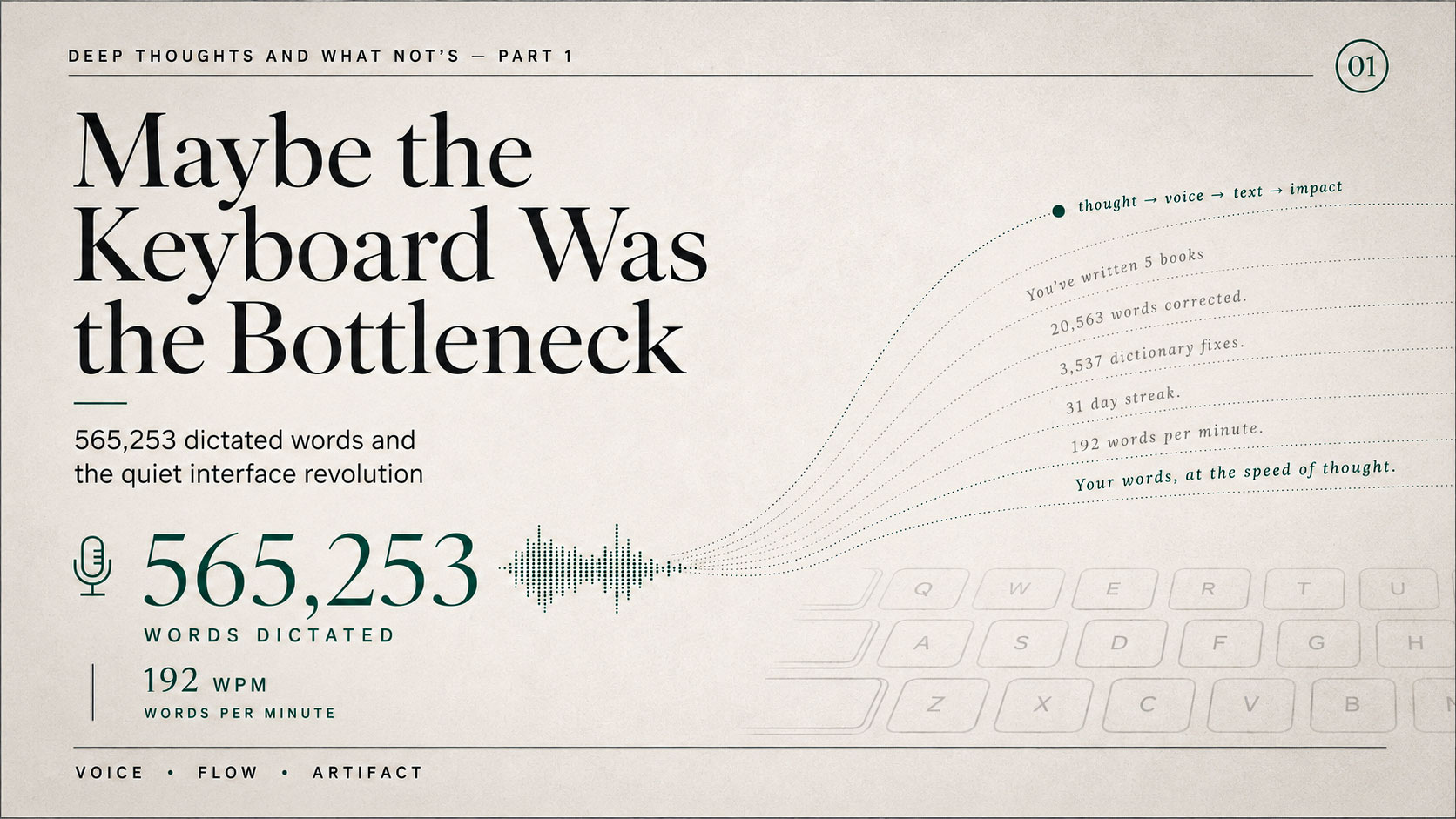
    Unfortunately for my forehead, I recently learned that I have dictated 565,253 words using Wispr Flow.

    The app describes that as five complete books.

    I did not set out to dictate five books. I was trying to make things: applications, reports, newsletters, learning experiences, client communications, prototypes, scripts, research, software tests, and all the strange connective tissue that eventually turns an incomplete thought into something useful.

    My dashboard also says I have a 31-day streak.

    That is technically true, but slightly misleading. Thirty-one days is simply how long it has been since I last took a day off. There were probably another 20 or 30 days before that, followed by another stretch before that.

    The only time I am consistently not using Wispr Flow is when my wife and I are sleeping in our rooftop tent somewhere in the mountains.

    Apparently, trees remain one of the few places where I stop prompting.

    Does my brain actually move faster?

    People who know me have told me for years that my brain moves unusually fast.

    That sounds flattering, but it is not especially scientific. There is no dashboard in my skull reporting that Cameron’s Brain is operating in the top 0.1 percent, although Wispr does make that claim about my speaking speed.

    What I can say with more confidence is that typing has never kept up with the way I naturally develop ideas.

    I type badly.

    I make spelling mistakes. I change direction halfway through sentences. I stop to repair grammar that did not need to be repaired yet. I delete the same word five times while the larger thought quietly climbs out a window.

    Wispr reports that I dictate at approximately 192 words per minute.

    A large study based on 136 million keystrokes from 168,000 volunteers found that the average participant typed about 52 words per minute. Professionally trained typists commonly reached somewhere between 60 and 90. (cam.ac.uk)

    At those rates, my 565,253 dictated words represent approximately:

    • 49 hours of active dictation
    • 181 hours of average-speed typing
    • A theoretical difference of roughly 132 input hours
    • More than 16 eight-hour workdays

    That comparison is imperfect.

    Typing tests usually measure the transcription of prepared text. They do not fully capture what happens when someone is inventing, planning, editing, correcting, reconsidering, and trying to remember why the document exists in the first place.

    Wispr’s measurement is not necessarily identical to the methods used in academic typing studies either.

    Still, the difference is not hiding behind a decimal point.

    In a Stanford-led experiment comparing speech recognition with smartphone typing, English speech input reached 153 words per minute compared with 52 for typing, making speech approximately 2.9 times faster under controlled conditions. Speech also produced fewer corrected errors during entry, although slightly more uncorrected errors remained in the final text. (arxiv.org)

    My recorded ratio is closer to 3.7 times.

    The useful conclusion is not that I am some uniquely accelerated human specimen.

    The more interesting hypothesis is this:

    Perhaps my thinking was not the bottleneck. Perhaps the interface was.

    Dictation used to create a second job

    Speech-to-text is not new.

    For years, we were promised that dictation would free us from the keyboard. In practice, it often replaced slow typing with fast cleanup.

    You had to speak with the precision of an air-traffic controller:

    New paragraph. Open quotation mark. Delete previous word. No, previous word. Previous previous word.

    The software would misunderstand a name, substitute an unrelated word, miss the punctuation, and leave behind a document that looked as though it had been translated through three languages and a malfunctioning fax machine.

    Yes, you could produce more words.

    You could also produce a much larger archaeological site to excavate later.

    Sometimes it was easier to keep typing, delete the same word five times, and negotiate directly with the little red squiggly line.

    The important change is not merely that transcription has become more accurate.

    It is that AI can now make sense of language that is not yet clean.

    I do not need to dictate a perfectly constructed document. I need to provide enough signal for the system to understand:

    • what I am trying to accomplish,
    • what context matters,
    • what I noticed,
    • what I dislike,
    • what I want to change,
    • and what the thing might become.

    The breakthrough is not simply speech-to-text.

    It is intent-to-artifact.

    My grandfather already had this interface

    My grandfather’s generation understood part of this workflow.

    Back when the two-martini lunch was not a television joke but a calendar event, executives did not necessarily sit down and type their own correspondence.

    They dictated letters.

    They might walk around the office, speak in half-formed paragraphs, revise a sentence aloud, and hand the verbal fog to a secretary, receptionist, or office assistant who understood shorthand, typing, grammar, tone, and probably the exact moment to pretend they had not heard something.

    The executive supplied the intent.

    Another person absorbed the friction.

    It was an excellent system, provided you were the executive.

    The rest of us eventually became our own thinkers, typists, editors, proofreaders, formatters, filing clerks, and occasional IT departments. Every idea had to squeeze through the same narrow keyboard before it could become useful.

    AI has quietly returned part of the old executive dictation model.

    We just lost the corner office, stenography pad, payroll, and medically questionable lunch.

    I can sit at my desk and speak as quickly and imperfectly as I think. A computer captures the language, repairs parts of it, identifies patterns, organizes the material, and helps turn it into something another person can use.

    I have apparently recreated the 1960s executive suite, except the secretary is artificial, the bar cart is missing, and I am both the boss and the person most likely to be asked to keep it down.

    The website review that stopped being a project

    Recently, an old friend asked me to look at his website and tell him what I thought.

    That sounds like a small favor.

    Historically, it could have become a fairly large task.

    I would have needed to browse the site, remember what I noticed, take notes, revisit certain pages, organize the observations, soften anything that sounded too abrupt, and write a response that justified the time he had taken to ask me.

    Instead, I turned on Granola and explained what I was doing:

    I am transcribing this as a UAT session. I am going to narrate what I notice as I move through the website.

    Then I used the site.

    I went through it once, then again, and then again. I talked about the visual hierarchy, credibility, wording, navigation, places where the experience felt strong, and places where it became less clear.

    I did not stop to make every sentence elegant.

    I did not switch between browsing and note-taking.

    I did not attempt to reconstruct my first impression after the first impression had already disappeared.

    When I stopped, Granola took a few minutes to turn the session into usable notes.

    Something that could have consumed a large piece of the afternoon became an easy favor.

    More importantly, the feedback remained honest.

    It had not been slowly converted into polished corporate oatmeal by the effort of rebuilding it later. It captured what I actually experienced while using the site: where I hesitated, what caught my attention, what felt credible, and where the story weakened.

    The thinking became the documentation.

    AI gives us more reps

    The most underappreciated advantage of AI may not be that it makes one attempt faster.

    It is that it gives us many more attempts.

    When I am building an application, report, learning experience, or AI-powered tool, I may conduct ten or twelve narrated UAT sessions.

    I open the latest version.

    I explain what I am seeing, what works, what feels awkward, what is missing, what broke, and what I expected to happen instead.

    That narration becomes a transcript.

    The transcript goes back into AI.

    AI helps interpret it, organize the issues, make revisions, and produce another version.

    Then I do it again.

    Build. Narrate. Interpret. Revise. Test again.

    Traditional productivity math asks how much faster AI allows us to complete one deliverable.

    That misses the richer advantage.

    The better measure may be iteration density: how many meaningful cycles can I complete while the problem is still fully loaded in my head?

    Previously, every revision cycle carried administrative drag.

    I had to take notes, clean the notes, organize the notes, explain the notes, and then make the changes.

    That friction encouraged compromise.

    I might review something once, fix the obvious problems, and decide it was probably good enough.

    Not because I lacked judgment.

    Because repeatedly applying that judgment was expensive.

    AI changes the economics of revision. When each cycle becomes cheaper, I can take more swings before leaving the batting cage.

    The work improves not because AI produces perfection, but because I can keep testing and correcting while I still remember what perfection was supposed to look like.

    Creative context has a half-life

    There is real value in sleeping on an idea.

    Distance can reveal weak logic. A fresh morning can expose the paragraph that only seemed brilliant because it was written at 1:14 a.m.

    But stopping also has a cost.

    When I return to a project, I have to reload it:

    What was I trying to accomplish?

    Why did I make this choice?

    Which version was current?

    What was bothering me?

    What did I plan to do next?

    Why did this feel exciting yesterday?

    Some of that context returns. Some does not.

    That is why I often work in sprints. When I enter a flow state, I may stay with something for many hours. Occasionally, that means going for 15 hours until the idea reaches what I think of as a stable state.

    Stable does not mean finished.

    It means the important thing now exists outside my head. The structure is visible. The logic has been captured. The fragile energy that made it interesting has been converted into something sturdy enough to survive my absence.

    Research into writing offers a plausible explanation for why mechanical friction matters. Planning ideas and generating sentences both place demands on working memory. (jowr.org)

    Research into interruptions also describes a “resumption lag,” the period required to recover and resume a primary task after attention has been diverted. Reconstructing the original task context can itself require cognitive work. (pmc.ncbi.nlm.nih.gov)

    That does not prove that correcting one typo destroyed my creativity.

    It supports a more modest claim:

    Every unnecessary interruption competes with the thought I am trying to keep alive.

    Voice does not eliminate cognitive load.

    It allows me to spend more of it on the idea.

    Voice preserves momentum. AI preserves meaning.

    My old typing process forced creation and correction to happen almost simultaneously.

    I would generate a sentence, notice its grammar, repair it, reconsider the wording, question the point, and lose the larger trail I had been following.

    Voice and AI allow me to separate more of that work.

    Voice becomes the generator.

    I can wander, connect ideas, follow strange branches, repeat myself, reverse course, and continue speaking until the shape begins to emerge.

    AI becomes part of the evaluator.

    It can organize, compare, question, research, restructure, and help determine which parts deserve to remain.

    Typing often encouraged me to polish the sentence while the idea was still trying to be born.

    Dictation lets me mine the ore before deciding which pieces should become jewelry.

    Or gravel.

    There is always gravel.

    The picks and axes of AI

    Much of the AI conversation is aimed at the spectacular.

    We talk about agents replacing departments, synthetic video, autonomous software, robots, and models that apparently become smarter every Tuesday.

    Those developments matter.

    But some of the largest practical gains may come from much smaller changes in the normal day:

    • not losing an idea while correcting a word,
    • not cleaning a transcript before it becomes useful,
    • not taking separate notes while testing something,
    • not rebuilding context every time a project resumes,
    • not translating natural intent into rigid software commands,
    • not needing a polished prompt before beginning.

    These are the picks and axes of the AI era.

    They are not as exciting in a keynote.

    They are more useful on a Wednesday.

    My Wispr dashboard reports 24,100 fixes across those 565,253 words. It also shows 10,514 AI prompts across 41 desktop applications.

    Those numbers reveal something larger than a speech habit.

    They describe a production system.

    More thoughts get captured.

    The captured thoughts can be curated.

    The curated material can become applications, training, research, newsletters, tests, decisions, and feedback.

    Then the response creates another round of thought.

    Capture → Curate → Share → Respond → Improve

    Once that loop becomes fast enough, it stops feeling like a collection of administrative tasks.

    It becomes one continuous act of making.

    The accelerator still needs brakes

    There is a red-team version of this story.

    Flow feels productive, but sustained momentum can conceal declining judgment, repetition, physical fatigue, and the fact that I have apparently been pressing my forehead into a piece of podcast equipment for half a day.

    The same system that removes my natural stopping points may require me to create artificial ones.

    Going from zero to a stable state in one sprint can preserve the original energy of an idea.

    It can also turn the operator into a highly productive Victorian ghost.

    More output is not automatically better output.

    More iterations do not help if fatigue makes each one less perceptive.

    The future workflow needs both:

    • a larger creative accelerator,
    • and a better braking system.

    My hypothesis is not that everyone should speak continuously until they collapse near a microphone.

    It is that we should pay closer attention to the interfaces that either preserve or fracture the way we think best.

    Maybe the interface is the story

    I have used trackballs, touchscreens, styluses, strange mice, split keyboards, virtual-reality headsets, and enough productivity software to qualify as a small institutional buyer.

    None has changed the way I interact with a computer as much as being able to narrate what I am thinking and have the system understand what I mean.

    Most computer interfaces required humans to adapt themselves to the machine.

    We learned commands.

    We selected the correct menu.

    We completed the approved field.

    We compressed complicated intentions into whatever structure the software could accept.

    AI begins to reverse that relationship.

    The computer increasingly adapts to us.

    It can tolerate abandoned sentences, missing punctuation, repetition, corrections, nonlinear thought, and the verbal debris surrounding a worthwhile idea.

    The only interface I can imagine surpassing this is some Neuralink-like system that removes speech from the chain entirely.

    No keyboard.

    No microphone.

    No sentence required.

    The thought travels directly into the machine.

    That sounds wonderfully efficient.

    It also sounds like a spectacular way to discover how many of my thoughts should never escape quality control.

    Until then, voice may be close enough.

    I can think aloud. The software can tolerate the wreckage. AI can locate the idea inside it. And before the original spark disappears, I can turn it into something stable enough to survive the night.

    Maybe that is the overlooked AI revolution.

    Not that the machine can think for us.

    That, for the first time, it can keep up while some of us think out loud.


    Next in the series

    This article begins with one person, one microphone, and a computer capable of turning narration into useful material.

    The next article moves from I to we.

    What changes when Zoom, Teams, Google Meet, Granola, and similar tools capture not only a meeting’s decisions, but the differing perspectives, disagreement, context, and reasoning that produced them?

    Perhaps the conversation was not merely something that happened before the work.

    Perhaps the conversation was the work.